Rep 17. Or was it 19? Somewhere in the middle of a hard set your brain stops counting and starts negotiating, and the number you write down is more hope than history.
An AI push-up counter takes that job off you. Your phone sits on the floor, watches you move and counts only the reps you actually finish. Here's how it pulls that off, and how to set it up so it counts you fairly.
The short version
- The camera finds your joints in every frame. This is called pose estimation.
- The angle at your elbow tells the counter whether you're at the top or the bottom of a rep.
- A rep counts only when you go top, bottom, top. Half reps never finish the loop, so they never count.
- The same joint positions show your form: hips, head, depth, lockout and shoulders.
- If the counting runs on your phone, your video doesn't have to go anywhere.
Just want to start counting? How to count push-ups with your phone camera is the two-minute version. This post is the look under the bonnet.
Three ways to count push-ups, and what each one misses
Every push-up counter is answering one question: did a rep just happen? They answer it in very different ways.
Tap or clicker counter
- How it counts: you press a button after every rep.
- Good at: being simple. It works anywhere.
- Misses: the rep itself. Tap without going down and it still counts, and you have to break position to tap.
Proximity-sensor counter
- How it counts: the phone lies under your face and counts each time your nose or chin gets close to it.
- Good at: being hands-free.
- Misses: your hips, your lockout and your body line. All it knows is that your face got near the phone, and a nod can get your face near the phone.
Camera counter (an AI push-up counter)
- How it counts: the phone sits on the floor a short way off and watches your whole body, counting a rep only after a full down-and-up cycle.
- Good at: honest reps, plus form notes as you go.
- Needs: decent light, a steady phone and your whole body in the frame.
Only the camera actually sees your form.
The camera sees joints, not just pixels
To your phone, a video frame is a grid of coloured dots. It has no idea which of them are you.
That's where pose estimation comes in. A machine-learning model looks at each frame and estimates where your body's key points are. Google's open-source MediaPipe Pose Landmarker, for example, tracks 33 body landmark locations, such as shoulders, elbows, wrists, hips and ankles. Join the dots and you get the "skeleton" some apps draw over you.
One angle tells the top of a rep from the bottom
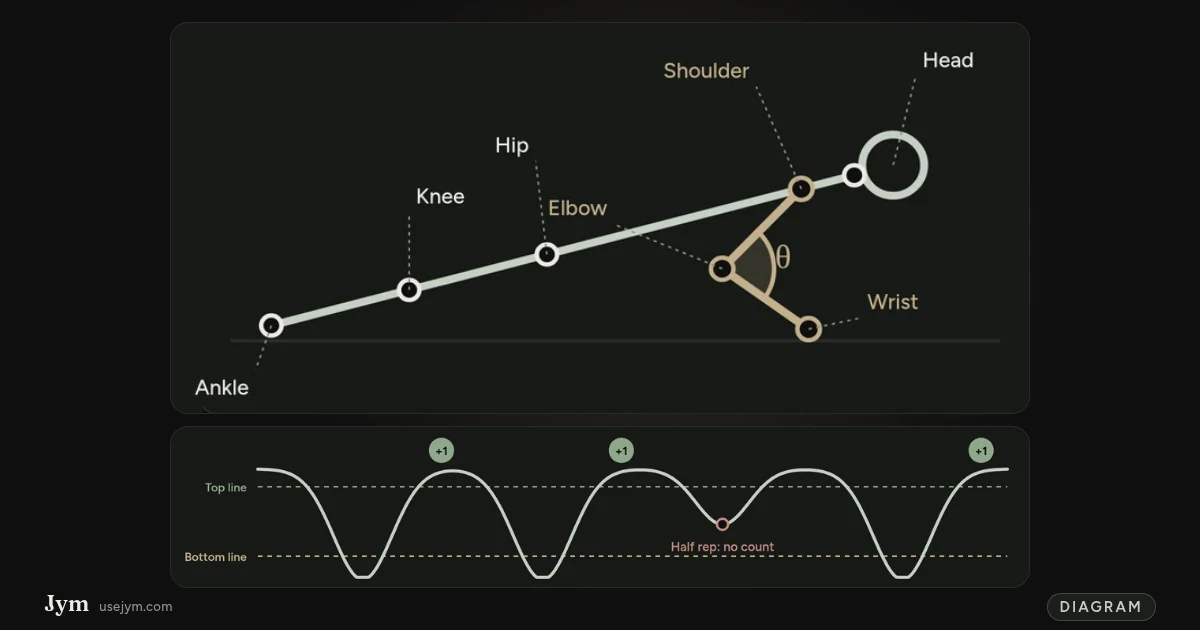
Once the counter knows where your joints are, counting is mostly geometry. It measures the angle at your elbow, between your upper arm (shoulder to elbow) and your forearm (wrist to elbow).
- Straight arms give a wide angle. You're at the top.
- Bent elbows give a small angle. You're at the bottom.
That one number, worked out many times a second, is enough to follow you through every rep.
Half reps don't finish the loop, so they don't count
The counting rule is short: top, bottom, top = one rep. In software terms it's a tiny state machine. The counter waits for you at the top, waits for you to reach the bottom, then waits for you to press back up. Only then does the number go up.
So picture rep 14 of a tough set. You drop halfway, think better of it and push back up. Your elbow angle never got small enough to reach "bottom", so the loop never closed and nothing was counted. Same story if you bounce back down before your arms straighten at the top.
A common approach is to use two thresholds rather than one: a "top" line and a "bottom" line. The gap between them helps stop a small wobble near either line being counted as an extra rep.
The same skeleton keeps an eye on your form
Better counters don't stop at the elbow. With the whole skeleton to hand they can also check:
- Your body line: shoulders, hips and ankles should stay in one line, so a hip that sags or rises shows up.
- Your head: whether it stays in line with your spine or drops towards the floor.
- Depth and lockout: whether you went all the way down and all the way back up.
- Your shoulders: whether one side dips lower than the other.
Those are the same things a coach would watch. For what good looks like on each, see the push-up form checklist.
Your video can stay on your phone
Modern phones are quick enough to run all of this on the device itself. That matters for privacy: if the counting happens on your phone, your video doesn't need to be uploaded anywhere just to count reps.
It also means a counter can run in an ordinary web browser, with no app-store download. Browsers can use your camera through a standard API once you give permission (MDN: getUserMedia). For how Jym handles this, see does Jym upload your video?
Set up your phone so it counts you fairly
A camera counter can only count what it can see. Four things make the difference between a solid count and a confused one:
- Phone on the floor, steady. Prop it against a water bottle, a shoe or a book, tilted slightly up. A wobbling phone makes for jumpy tracking.
- Your whole body in the frame, head to feet. If the app draws a skeleton, wait until it's tracking you steadily before you start.
- Face the light. A bright window behind you turns you into a silhouette, and silhouettes have very shy elbows.
- Contrast with the floor. Dark clothes on a dark rug are hard work for any model. Do two slow test reps before your real set.
With any camera counter, a side-on view shows the hip line best.
For Jym's own setup, see where to put your phone for push-ups.
An honest count is worth having
The count is your feedback loop. Getting stronger means doing a bit more over time: one more rep, one more set, or a cleaner rep than last week. Without an honest number you're guessing.
There may be more to it than that. A 2019 study in JAMA Network Open followed 1,104 active male firefighters for ten years. Men who could do more than 40 push-ups at baseline had a significantly lower incidence of cardiovascular events than those who managed 10 or fewer (Yang et al., 2019). That's an association in one specific group (active, mostly middle-aged men), not proof that push-ups prevent heart disease. Still, the Harvard T.H. Chan School of Public Health researchers behind it said push-up capacity could be a simple, no-cost way to help assess heart-disease risk (Harvard news release). Tracking a marker like that starts with counting it properly.
Make every rep a good one
A camera counter is strictest with reps that really are good push-ups. The American Council on Exercise's push-up guide covers the basics:
- Hands about shoulder-width apart, in a high plank.
- Brace your core so your body forms one straight line from head to heels. No sagging hips, no bum in the air.
- Lower yourself under control until your chest is close to the floor.
- Press back up to straight arms at the top. That's your lockout.
If full push-ups are too hard right now, knee push-ups or incline push-ups (hands on a bench or kitchen counter) use the same pattern and are a perfectly good place to start.
Try it on your next set
Jym is an AI push-up counter that runs in your phone's browser. It's free to start: one counted set a day, with nothing to download and no account. Jym Pro ($6 a month or $29 a year) adds unlimited sets, the voice coach and recordings.
Phone on the floor, you facing it. The skeleton goes green when Jym has locked onto you, and counting starts after that. As you go it gives short form notes (hips sagging, hips too high, short range, no lockout, head dropped, uneven shoulders) and keeps your streak, personal best and training log. Sign in and there's a simple leaderboard too. With Pro you can record a set to replay (recordings are off by default and stay in the browser on that phone) and turn on the voice coach (hype, savage or calm).
Next time you lose count around rep 17, let your phone keep score: open Jym and start counting.
Questions
How does an AI push-up counter count reps?
It uses pose estimation to find your joints in each camera frame, measures the angle at your elbow, and counts one rep each time you go from straight arms to the bottom position and back up to straight arms.
Does a half rep count?
Not on a counter that uses a top-bottom-top rule. A rep that never reaches the bottom position, or never presses back up to straight arms, doesn't complete the cycle.
Does an AI push-up counter need to upload my video?
Not if the counting runs on the device. Jym reads the camera and works out the count on your phone, and the video isn't uploaded.
How much does Jym cost?
Jym is free to start: one counted set a day, with nothing to download and no account. Jym Pro ($6 a month or $29 a year) adds unlimited sets, the voice coach and recordings.
This article is general information, not medical advice. If you have a health condition or injury, check with a professional before starting a new exercise routine.