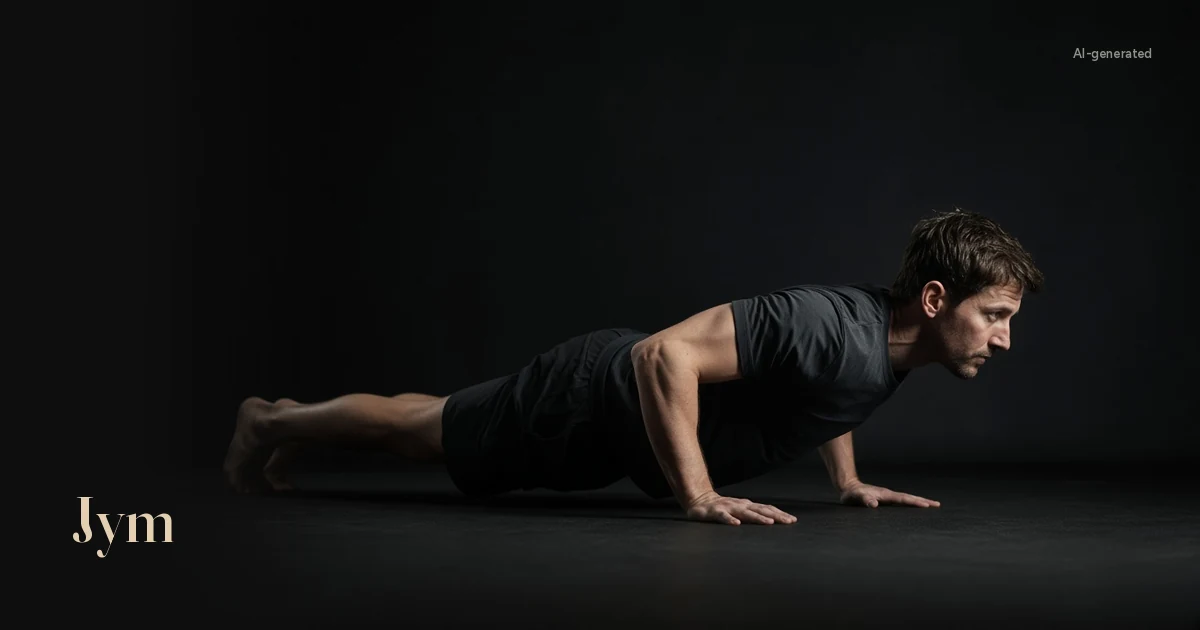
Rep 3 looks like the photo in a textbook. Rep 13 looks like someone else wearing your T-shirt: hips sinking, elbows sticking out like a startled chicken, chin bobbing at the carpet while your chest stays politely where it was.
Nobody sets out to do bad push-ups. The mistakes creep in when you get tired, because your body is very good at finding an easier way to make the number go up. This guide covers eight that come up again and again in coaching guides, why each one happens, how to spot it when you can't see yourself, and the fix.
If you'd rather start with what a good rep looks like, the push-up form checklist is the positive version of this page.
The short version
- Hips sagging: squeeze your bum and brace your stomach, not just your thighs.
- Hips too high: lower them until shoulders, hips and heels line up.
- Head dropping: keep it in line with your spine and let your chest lead.
- Half reps at the bottom: fewer reps, all the way down.
- No lockout at the top: push the floor away until your arms are straight.
- Elbows flaring into a T: bring them in closer to your sides.
- Hands too far forward: start with your shoulders over your hands.
- One side dipping: slow down, re-set your hands, and end the set when it won't stay level.
Most of the cues below come from two published guides: the American Council on Exercise's push-up guide and Cleveland Clinic's how to do a push-up, written with an exercise physiologist. The "why it happens" notes are general coaching pointers, not a diagnosis.
Mistake 1: hips sagging
What it looks like: your lower back dips towards the floor like a hammock, and your hips touch down before your chest.
Why it creeps in: your trunk is tiring before your arms are. Cleveland Clinic's physiologist points out that many people squeeze their thighs instead of their bum and stomach, which can lead to sagging in the middle.
The fix: before the first rep, squeeze your bum and brace your stomach as if you're about to be poked in the ribs. ACE's cue is simple: don't let your low back sag.
Mistake 2: hips too high
What it looks like: your bum rises until your body is an upside-down V. The push-up feels easier, because it is.
Why it creeps in: lifting your hips shifts weight off your arms. It's often what tired arms do to keep going.
The fix: lower your hips until your shoulders, hips and heels make one straight line. If you can only hold that line on your knees right now, that's a better rep than a pike on your toes. See knee push-ups vs full push-ups.
Mistake 3: head dropping
What it looks like: your chin or nose reaches for the floor while your chest stays high. It feels like depth. It isn't.
Why it creeps in: when you can't lower your chest any further, dropping your head gets something close to the floor.
The fix: keep your head in line with your spine, from the top of the rep to the bottom. Both ACE and Cleveland Clinic say this. Look at the floor a little ahead of your hands rather than between them, and let your chest lead the way down.
Mistake 4: half reps at the bottom
What it looks like: reps that stop a few centimetres down. Usually the first few are fine and the last few get shorter and shorter.
Why it creeps in: fatigue. The bottom of the push-up is the hardest part, and it's the first thing to go.
The fix: lower under control until your chest or chin reaches, or nearly reaches, the floor. If you can't do that for the number you planned, do fewer reps. It's not just about looking tidy: the American College of Sports Medicine's 2026 position stand found strength gains were enhanced by training through a complete range of motion (Currier et al., 2026).
Mistake 5: no lockout at the top
What it looks like: you bounce back down before your arms straighten. From the side, your elbows never quite open up.
Why it creeps in: rushing. Short, fast reps feel productive and inflate the count.
The fix: finish every rep with straight arms before you start the next one. ACE's cue is to think about "pushing the floor away from you".
Mistake 6: elbows flaring into a T
What it looks like: from above, your arms and body make a T, with your elbows pointing straight out to the sides.
Why it creeps in: hands set too wide, or a habit from wide-grip push-ups. Cleveland Clinic's physiologist prefers the shoulder-width "military" style, saying there's less chance of over-using the shoulders than with a wider position.
The fix: keep your elbows closer to your sides as you lower. ACE's standard push-up lets the elbows flare out a little as you lower, so the fault is a full T. ACE's alternative, with hands facing forward and elbows close to your sides, shifts the emphasis onto the triceps and may reduce stress on the shoulder joint. You don't need them pinned to your ribs, just angled back rather than out.
Mistake 7: hands too far forward
What it looks like: at the top, your hands are in front of your shoulders instead of underneath them.
Why it creeps in: setting up in a hurry, or walking your hands out to make the plank feel easier.
The fix: start on your hands and knees with your hands shoulder-width apart and directly below your shoulders, as Cleveland Clinic describes, then step your feet back into the plank. Check the position again whenever you re-set.
Mistake 8: one side dipping
What it looks like: one shoulder drops lower than the other, or your body twists as you press.
Why it creeps in: one side tiring first, hands set unevenly, or simply going too fast to notice.
The fix: slow down and re-set your hands evenly. When a rep won't stay level, that's the end of the set.
The real root cause: the set went on too long
Look back at that list and most of the "why it creeps in" lines say the same thing: you got tired. The fix that covers almost all of them is to end the set at the first rep that breaks, not the third.
You don't lose much by stopping early. The ACSM's 2026 position stand notes that training to failure isn't required for good results (full text). An extra set of clean reps beats three ugly ones at the end of the last set.
How to spot mistakes when you train alone
You can't see your own hips. Here are three ways round that:
- Film a set side-on, at about floor height. Pause the video at the bottom and the top of your last three reps. Hips, head, depth and lockout are all easiest to judge from the side.
- Film a set from the front to check your elbows and whether one shoulder dips.
- Use a camera counter that checks as you go. Jym's form notes cover six of the eight mistakes here (more on that below).
Can a camera catch these?
Partly, and it's worth knowing which parts. Jym is an AI push-up counter that runs in your phone's browser. Phone on the floor, you facing it, whole body in frame. Its short form notes are hips sagging, hips too high, short range, no lockout, head dropped and uneven shoulders. That covers mistakes 1 to 5 and mistake 8 (hip notes work best when the camera sees you side-on).
It doesn't give notes on hand position or elbow flare, so mistakes 6 and 7 are still down to you, a mirror or a video. It also won't count a rep that skips the bottom or the top, so half reps simply don't make the number. How an AI push-up counter works explains why.
Jym is free to start: one counted set a day, with no account required. Jym Pro ($6 a month or $29 a year) adds unlimited sets, the voice coach and recordings, which are off by default and stay in the browser on that phone. See which of your reps Jym counts.
Questions
What is the most common push-up mistake?
There's no official ranking, but sagging hips and short range (stopping before the bottom) feature in most coaching advice. Both tend to appear late in a set as you tire, which is why ending the set at the first broken rep fixes so much.
Should your elbows flare out during push-ups?
Not into a T. Keep your hands about shoulder-width apart and your elbows angled back, closer to your sides. ACE notes that keeping the elbows close to your sides may reduce stress on the shoulder joint.
Should your chest touch the floor in a push-up?
Your chest or chin should reach, or nearly reach, the floor, with your body in a straight line. A head that drops to the floor while your chest stays high doesn't count as depth.
Is it better to do fewer push-ups with good form?
Yes. A shorter set of full-range reps trains the movement you actually want. The ACSM's 2026 position stand found strength gains were enhanced by training through a complete range of motion.
This article is general information, not medical advice. If you have pain, an injury or a health condition, check with a professional before starting a new exercise routine.