You did 30 push-ups. Then you watched the video back, and the last eight were more of a polite nod towards the floor.
It happens to everyone. As you tire, reps get shorter, hips drift and your head starts doing the work your chest should be doing. None of it feels like cheating at the time. These six checks keep every rep honest, with a quick fix for each.
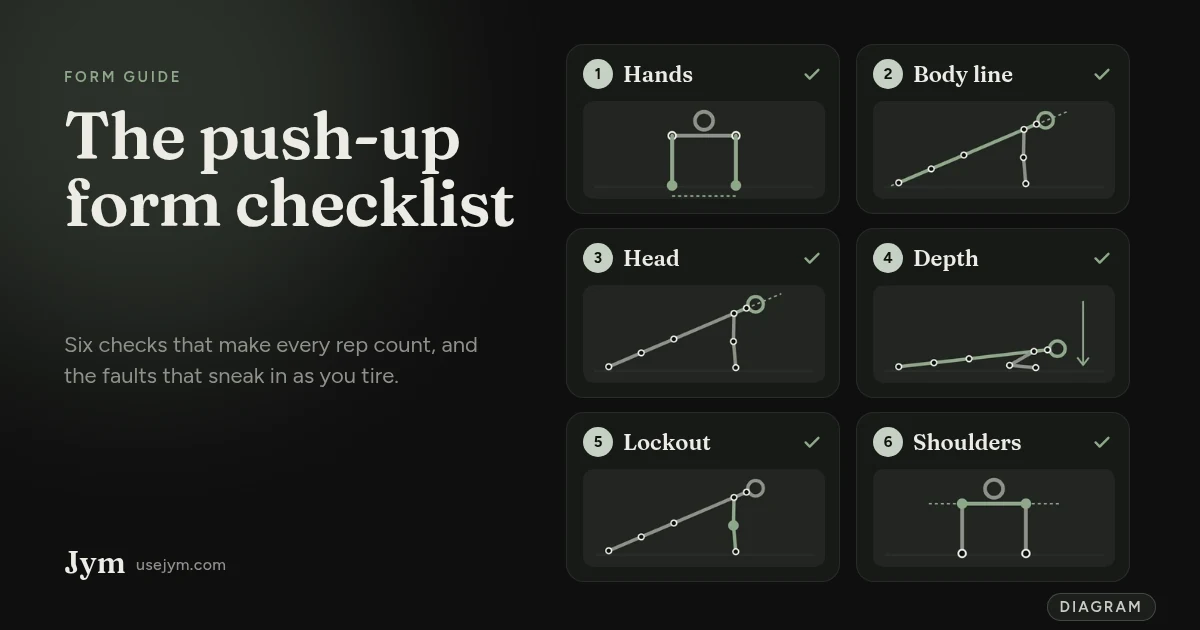
The short version: check these six on every rep
- Hands: about shoulder-width, under your shoulders.
- Body line: one straight line from head to heels.
- Head: in line with your spine.
- Depth: chest or chin to, or nearly to, the floor.
- Lockout: arms fully straight at the top.
- Shoulders: level on both sides.
Most of the cues below follow two published guides: the American Council on Exercise's push-up guide and Cleveland Clinic's how to do a push-up, written with an exercise physiologist.
1. Hands: start from a shoulder-width base
Check: palms flat, hands about shoulder-width apart, fingers facing forward, shoulders stacked roughly over your hands at the top.
Looks wrong: hands creeping out wide as the set goes on.
Why it matters: Cleveland Clinic's physiologist prefers the shoulder-width ("military") position, saying it carries less risk of over-using the shoulders than a wide stance. ACE also notes that keeping your elbows closer to your sides shifts work towards the triceps and may reduce stress on the shoulder joint.
2. Body line: move as one plank, head to heels
Check: brace your stomach and squeeze your glutes, so your body stays rigid from head to heels on the way down and the way up.
Looks wrong:
- Hips sagging. Your lower back dips towards the floor, like a hammock. Cleveland Clinic's tip is to tighten your bum and stomach rather than just your thighs, because squeezing only the quads can lead to sagging in the middle.
- Hips too high. Your bum rises until your body is an upside-down V. ACE's cue covers both faults: don't let your low back sag or your hips hike upwards.
3. Head: keep it in line so the depth is real
Check: your head stays in line with your spine, from the top of the rep to the bottom.
Looks wrong: a dropped head, where you reach for the floor with your chin or nose while your chest stays high. It feels like depth. It isn't. Both guides say to keep your head aligned with your spine throughout.
4. Depth: go low enough for the rep to count
Check: lower yourself under control until your chest or chin reaches, or nearly reaches, the floor.
Looks wrong: short range, meaning reps that stop a few centimetres down. It usually creeps in late in a set, as you tire. A rep that stops short is a different, easier exercise. If you can't hit full depth for the number you're aiming for, do fewer full reps rather than more half reps.
5. Lockout: finish every rep with straight arms
Check: press until your arms are fully extended at the elbows before you start the next rep. ACE's cue is to think about "pushing the floor away from you".
Looks wrong: no lockout, bouncing back down before your arms straighten. Like short range, it shrinks the movement and quietly inflates the count.
6. Shoulders: keep them level from first rep to last
Check: both shoulders rise and fall together, with your chest square to the floor.
Looks wrong: uneven shoulders, where one side dips lower or your body twists as you press. Slow down, re-set your hands evenly, and end the set when you can't keep it level.
Quick fixes: fault, common cause, fix
When a rep goes wrong, it's usually one of these. The causes are general coaching pointers, not a diagnosis, and the same fault can have other causes.
- Hands set very wide. Often: setting up without checking, or hands drifting during the set. Fix: bring them back to about shoulder-width, under your shoulders.
- Hips sagging. Often: squeezing only your thighs, not your bum and stomach. Fix: squeeze your bum and brace your stomach as well.
- Hips too high. Often: lifting your hips to take weight off your arms. Fix: lower your hips until shoulders, hips and heels line up.
- Head dropped. Often: reaching for the floor with your chin to make the rep feel deeper. Fix: keep your head in line with your spine and let your chest lead.
- Short range. Usually: tiring late in the set. Fix: do fewer reps, all the way down.
- No lockout. Often: rushing into the next rep. Fix: push the floor away until your arms are straight.
- Uneven shoulders. Often: one side tiring first, or hands set unevenly. Fix: slow down, re-set your hands, and stop the set when it won't stay level.
Too hard? Make it easier without changing the pattern
If full push-ups are too much right now, keep the same checklist and change the angle instead:
- Knee push-ups: same straight line, but from your knees to your head.
- Incline push-ups: hands on a wall, a kitchen counter or a sturdy table. Cleveland Clinic's physiologist suggests working down gradually from higher surfaces to the floor.
You don't need to do them every day, either. Cleveland Clinic notes that three to four days a week is great.
Training alone? Three ways to check yourself
The awkward thing about form is that you can't see yourself doing it.
- Film a set from the side and watch it back. Hips, head, depth and lockout are all easiest to judge side-on.
- Use a mirror for your body line, if you have one at floor level.
- Use a camera-based counter that checks form as you go. An AI push-up counter tracks your joints and only counts a rep when you go all the way down and back up. How an AI push-up counter works explains the method.
Let your phone watch your form
Jym does this in your phone's browser, using the camera. It counts your reps, and its short form notes cover most of this checklist: hips sagging, hips too high, short range, no lockout, head dropped and uneven shoulders. It's free to start: one counted set a day, with nothing to download and no account. Jym Pro ($6 a month or $29 a year) adds unlimited sets, the voice coach and recordings.
To set it up, see how to count push-ups with your phone camera and where to put your phone. Then do one set and see how many of your reps were real ones: try Jym.
Questions
How low should a push-up go?
Lower under control until your chest or chin reaches, or nearly reaches, the floor, then press back up until your arms are fully straight.
Where should my hands go for a push-up?
About shoulder-width apart, palms flat, fingers facing forward, with your shoulders roughly over your hands at the top.
What if I can't do a full push-up yet?
Keep the same straight body line and make it easier with knee push-ups or incline push-ups on a wall, counter or sturdy table, then work down towards the floor over time.
How often should I do push-ups?
They don't have to be daily. Cleveland Clinic's exercise physiologist says three to four days a week is great.
This article is general information, not medical advice. If you have pain, an injury or a health condition, check with a professional before starting a new exercise routine.