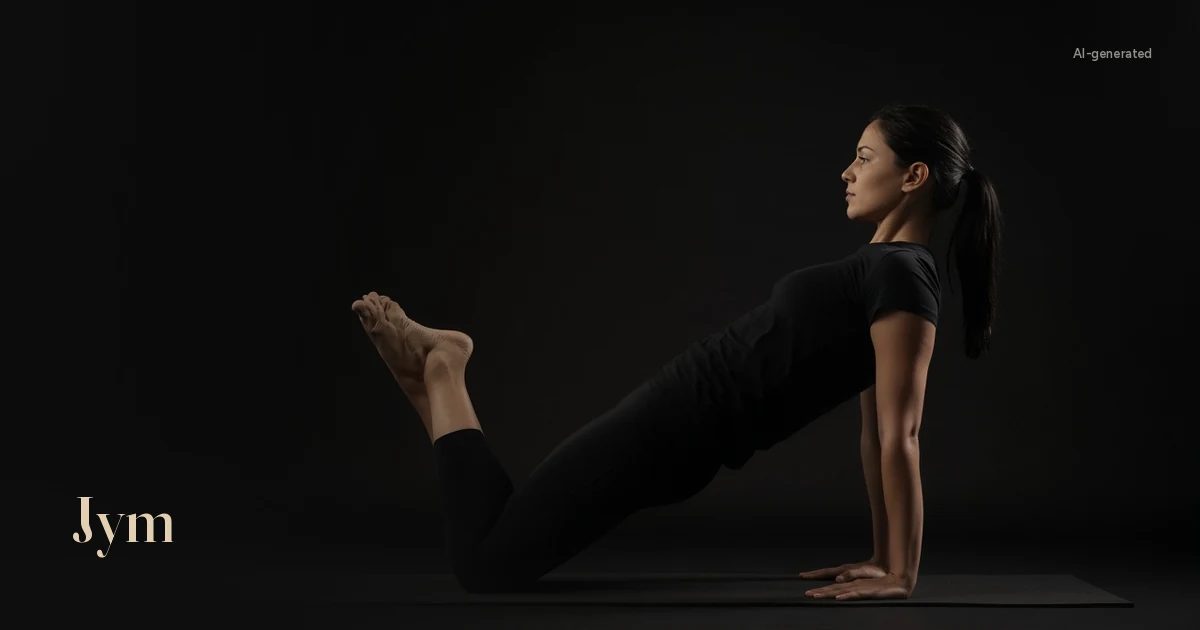
Rep 6 on your toes, and your hips start to sink. Drop to your knees and you could knock out 15 more. So which set did more for you: six wobbly full push-ups, or fifteen solid knee ones? And are knee push-ups "real" push-ups at all?
They are. They're also lighter, by a measurable amount. Here's what changes when your knees go down, what stays the same, and a simple rule for when to move up to your toes.
The short version
- A knee push-up is the same movement with a shorter lever, so less of your body weight goes through your hands.
- In one force-plate study, a regular push-up loaded the hands with about 64% of body weight and a knee push-up about 49%.
- Knee push-ups still build strength, as long as the sets are hard enough and the form is good.
- Incline push-ups (hands on a counter or bench) are the other easy option, and they keep the full plank from your feet.
- Switch when you can do 3 sets of 12 to 15 clean knee push-ups. Mix the two for a while before you drop the knees altogether.
What actually changes: the lever
In a push-up your body is a lever. Your hands push, and the pivot is wherever you're touching the floor at the other end: your feet in a full push-up, your knees in a knee push-up.
Move the pivot from your feet to your knees and two things happen. The lever gets shorter, and your lower legs stop being part of the load. Both mean less weight through your hands.
The numbers from three studies:
- Ebben and colleagues (2011) measured peak force under the hands on a force plate. A regular push-up came to about 64% of body weight and a bent-knee push-up about 49% (Ebben et al., 2011, figures as summarised in Kikuchi and Nakazato, 2017). On those figures, a knee push-up is roughly three-quarters of the load of a full one.
- Gouvali and Boudolos (2005) found the initial load was 66.4% of body weight in a normal push-up and 52.9% on the knees, and that chest and triceps muscle activity was lower in the knee version (Gouvali and Boudolos, 2005).
- Suprak and colleagues (2011) found that in both versions people supported less weight at the top than at the bottom, and that the jump from top to bottom was bigger in the knee push-up (Suprak et al., 2011). In other words, the bottom is the hard part in both. Don't skip it.
These were small groups of fit adults, mostly men, and your exact numbers will depend on your build. The direction is clear, though: knees down means meaningfully lighter.
What stays the same
- The pattern: hands about shoulder-width apart, lower under control, press to straight arms.
- The body line: straight from your knees to your head. The plank still matters, it just starts at your knees.
- The main muscles: chest, shoulders and triceps, working through the same range. They're just working against less load.
Do knee push‑ups build strength?
Yes, if the sets are hard enough. In one small study, young men did push-ups with their position adjusted (for example, kneeling) so the load matched a bench press at 40% of their one-rep max. Twice a week for eight weeks, they gained strength and muscle thickness comparable to the bench-press group (Kikuchi and Nakazato, 2017).
That fits the broader picture. The American College of Sports Medicine's 2026 position stand concluded that many forms of resistance training work, and that the key is training with high effort at least twice a week (Currier et al., 2026). Fifteen solid knee push-ups that leave you with a couple in reserve are hard effort. Six full push-ups with sagging hips are mostly practice at sagging.
Knee push‑ups vs incline push‑ups
Both make push-ups easier. In Ebben's study, push-ups from the knees and push-ups with the hands raised on a box both produced lower forces than every other variation tested (Ebben et al., 2011). They suit slightly different people:
Knee push-ups
- Good for: training anywhere on the floor, and getting used to the bottom position near the ground.
- Watch out for: bending at the hips so your bum sticks back. That turns it into a half-kneel, not a push-up.
- Fine-tuning: limited. It's knees or toes.
Incline push-ups (hands on a counter, table, bench or step)
- Good for: keeping the full plank from your feet, so you practise exactly the body line a full push-up needs.
- Watch out for: anything that might slide or tip.
- Fine-tuning: excellent. Every lower surface is a small step harder. Cleveland Clinic's exercise physiologist suggests starting high and working down gradually (Cleveland Clinic).
If your hips sag or pike on your toes, inclines are often the better bridge, because they train the plank you'll need. If you just want the simplest floor option, knees are fine. Plenty of people use both. Push-ups for beginners lays out the full ladder from wall to floor.
Common knee push‑up mistakes
- Bum in the air. Your hips should be in line between your knees and shoulders, not bent.
- Knees too close to your hands. Shuffle your knees back until there's a straight line from knees to head.
- Half depth. The knee version tempts you to bob. Lower until your chest nearly reaches the floor.
- Hard floor. A folded towel or mat under your knees makes it far more comfortable.
The rest of the rules are the same as for full push-ups. The push-up form checklist covers them all, and push-up form mistakes explains why they creep in.
When to switch from knees to full push‑ups
Use a simple rule of thumb: when you can do 3 sets of 12 to 15 clean knee push-ups, start bringing full push-ups in. Don't switch overnight. Mix them:
- Full first, knees to finish. Do full push-ups until your form starts to break, then drop to your knees and finish the set.
- One full set, then knees. Start each session with one set of full push-ups, then do the rest on your knees.
- Slow lowering from your toes. Lower slowly from a full plank, then put your knees down to press back up.
Each session, try to do a rep or two more on your toes before the knees go down. When you can do 3 sets of 8 or so full push-ups, the knees become a warm-up rather than a crutch.
Test it honestly
The moment of truth is the first set of full push-ups, and it's easy to fudge: a slightly short rep here, a hip that sags there. Count it properly, and you'll know exactly when you've made the switch.
Jym is an AI push-up counter that runs in your phone's browser. Phone on the floor, you facing it, whole body in frame from head to feet. It counts a rep only when you go all the way down and back up to straight arms, and it gives short form notes (hips sagging, hips too high, short range, no lockout, head dropped, uneven shoulders). Use it for your full push-up sets and the training log shows the week your knees came off the floor.
It's free to start: one counted set a day, with no account required. Jym Pro ($6 a month or $29 a year) adds unlimited sets, the voice coach and recordings. Test your full push-ups with Jym.
Questions
Are knee push-ups effective?
Yes. They work the same muscles through the same movement with less load. In a small study, push-ups adjusted to a lighter position, such as kneeling, built strength and muscle comparable to bench pressing over eight weeks.
How much easier are knee push-ups than regular push-ups?
In one force-plate study, a regular push-up put about 64% of body weight through the hands, and a knee push-up about 49%. Another study found 66.4% and 52.9%. Your exact numbers will depend on your build.
Should I do knee push-ups or incline push-ups?
Both work. Incline push-ups keep the full plank from your feet and let you make small steps by using lower surfaces. Knee push-ups are easier to do anywhere. If your hips sag on your toes, inclines are often the better bridge.
When should I switch from knee push-ups to full push-ups?
A good rule of thumb is when you can do 3 sets of 12 to 15 clean knee push-ups. Start by doing full push-ups until your form breaks, then finish the set on your knees.
Do knee push-ups work the same muscles as full push-ups?
They work the same main muscles: chest, shoulders and triceps. One study measured lower chest and triceps activity on the knees, which fits with the lighter load.
This article is general information, not medical advice. If you have pain, an injury or a health condition, check with a professional before starting a new exercise routine.