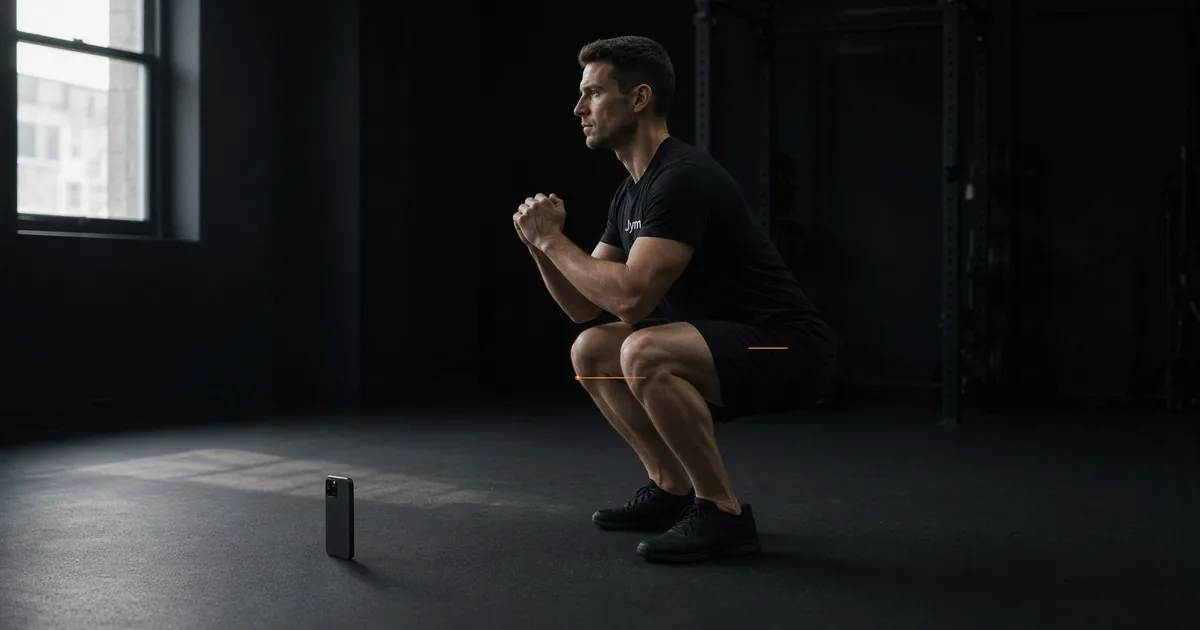
Ten to twenty, at full depth. That is a fair first day if you have not been squatting. A hundred is a number from a video, not a starting point. The right daily number is the biggest set you can finish with the last rep as deep as the first.
Depth is the whole exercise. Hips below the knees, heels down, then all the way back up. A squat that stops halfway is a knee bend. Doing more of those does not make the day harder in a useful way. It just makes the log a lie.
Find your number
Do one set. Stop when the next rep would be shallower, or when the heels come up, or when the chest falls. That count is today's number.
If it was under 10, stay there for a week. If it was 15 and the last three were still deep, 15 is your challenge. Add five only when a whole week of that number felt ordinary. Two or three sets is plenty. You do not need to squat every hour.
How Jym counts them
Prop the phone upright, portrait, about 2–3 metres away, you side-on, head to feet in the frame. Jym locks on, then counts a rep when you go down and come all the way back up.
The notes are short. "Go a bit lower." "Push your knees out." "Keep your heels down." "Chest up." Beginner depth is on for the first few squat sets, so a slightly higher squat still counts while you are learning the bottom. You can turn it off.
A challenge that stays yours
Set the daily target on a challenge and start the set from that card. If you are on a 30-a-day and a 15-a-day at the same time, the 15 you just did belongs to the one you started. It is not added to both. Each challenge counts its own sets.
Squat days stay off your push-up log, your sit-ups and your plank times. The leaderboard for squats is squat reps.
The first set is free. Sign in and everything is free for 48 hours. Then Pro is $6 a month or $29 a year.
Not medical advice. Stop if anything hurts. Knees that pinch are a reason to shorten the depth or stop, not a reason to add reps.